
If you are about to play your first padel match, you probably have the same question we had at the beginning: “What are the basic rules?”
The good news is that the rules of padel are much simpler than they look. In just a few minutes you can learn the essential rules and go on court without wondering at every point whether you did it right or not.
In this guide we explain the official padel rules in force in 2026 in a simple, easy-to-understand way, without going into complicated situations you probably won’t come across in your first matches.
How to win a padel match
Normally a padel match is played as “best of 3 sets”. The team that wins two sets first is declared the winner.
At PADELXP we recommend playing full matches and not just rallying. Even if at first it is tempting to hit the ball without keeping score, real progress comes when you learn to play under the pressure of the score and build your game tactics.
How to keep score
The score in a game is the same as in tennis. The order of points is:
0 → 15 → 30 → 40 → Game
- The first to reach 6 games, with a margin of at least two games, wins the set.
- If the score reaches 5-5, the set can continue up to 7-5.
- If it reaches 6-6, a tie-break is played to decide the winner of the set.
What happens in a game at 40-40

There are three variants in use today.
Classic advantage
- These are the traditional rules.
- At 40-40 (deuce), the team that wins the next point gets the advantage.
- If it loses the next point, the score goes back to deuce.
- The game ends only when one of the teams wins two consecutive points after 40-40.
- This variant can make a game last quite a long time.
Golden Point
- This is the preferred variant in many modern tournaments and leagues.
- At the first 40-40, a single deciding point is played.
- The receiving team chooses which of its two players will receive the deciding serve.
- The team that wins that point automatically wins the game.
- The advantage is that matches become shorter and fit more easily into the court booking time.
Star Point
- It is an intermediate variant between classic advantage and Golden Point.
- At 40-40, a maximum of two rounds of advantage can be played
- If, after these two rounds of advantage, the score goes back to deuce (40-40), the next point becomes decisive and determines the winner of the game.
- If Star Point is reached, the receiving team chooses which of its two players will receive the deciding serve.
- It is a very good solution when you want to keep some of the tension of classic advantage without the risk of games that go on for a very long time.
The PADELXP recommendation
If you book the court for only 90 minutes, we recommend Golden Point or Star Point. You will finish the full match much more often.
If time is not an issue and you prefer the traditional rules, you can play with classic advantage.
How to serve correctly
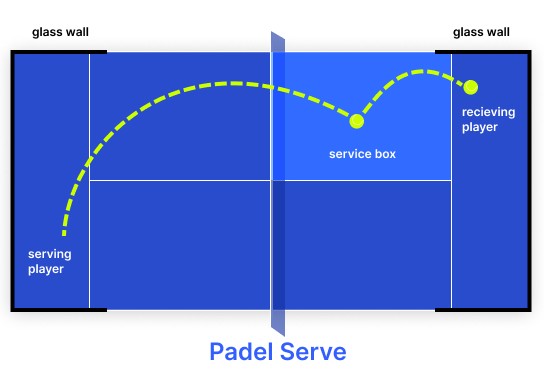
The serve is one of the most important rules in padel.
On every point:
- the serve is played diagonally;
- the first point of each game is served from the right-hand side, the next from the left, alternating after each point;
- the ball must be allowed to bounce once on the court before it is hit;
- the ball must be hit below waist height;
- at the moment of the hit, at least one foot must be in contact with the ground and the server must be behind the service line;
- the ball must not cross the service line before it is hit;
- the ball must first land in the opponent’s service box;
- after landing on the opponent’s court, the ball may hit the glass;
- however, if the ball hits the opponent’s fence directly, the serve is a fault;
- for each point of the game, the player is entitled to two serve attempts.
The serve alternates between the players of the same team after each game.
Basic rules during play

Once the ball is in play, the rules are fairly simple.
You are allowed
- to volley the ball (without letting it bounce);
- to let the ball bounce once on the court;
- to use the glass on your own side to return the ball;
The point ends when:
- the ball bounces twice on the court;
- the ball goes straight into the net and does not land in the opponent’s court;
- the ball goes straight into the opponent’s glass or the fence (anywhere) without touching the court;
- the ball is hit out of the court and lands on the ground outside it;
- one of the teams commits a fault.
Faults – what you are NOT allowed to do
During a point it is forbidden:
- to touch the net with your body or your racket;
- to hit the ball twice;
- to touch an opponent with your hand or your racket;
- to hit the ball on the opponent’s side before it has crossed the net.
There is one exception, however
If the ball has already landed in your court and, because of the bounce or spin, comes back over the net by itself, you may reach over the net with your racket and hit it on the opponent’s side before it touches the ground, as long as you do not touch the net.
Tie-break
If a set reaches 6-6, a tie-break is played.
- The tie-break is won by the team that first reaches 7 points, with a margin of at least two points.
- If the score reaches 7-7, play continues until there is a two-point margin.
- The players change ends every 6 points played.
Super Tie-break (Maxi Tie-break)
In many tournaments, or when time is limited, the third set can be replaced by a Super Tie-break, also known as a Maxi Tie-break.
It is played to 10 points, again with a margin of at least two points.
Example:
- first set: 6-4
- second set: 4-6
- instead of the deciding set, a Super Tie-break to 10 is played.
This variant allows matches to finish in less time and is very often used in amateur competitions.
Special rules and situations

Once you understand the basic rules, it is worth knowing a few situations that often cause confusion.
When can the glass be used?
The glass walls are one of the elements that set padel apart from other racket sports.
✅ 1. You can let the ball hit your glass
If the ball has first landed on your court, you can let it bounce off the glass and then hit it. This is one of the most important things a beginner has to learn.
Tip for beginners: don’t try to avoid the glass. In padel, the glass is your ally. Often, after bouncing off it, the ball loses speed and becomes easier to control than if you tried to hit it before the glass. Learn to use the glass as early as possible and your game will progress much faster.
✅ 2. You can also use the glass to send the ball back
You don’t have to hit the ball directly. You can deliberately hit the ball into the glass behind you (contra pared) or to your side, if that helps you send it into the opponent’s court more effectively.
✅ 3. If your opponent’s ball hits the glass directly, you win the point
If the ball comes towards you and hits the glass directly, without first touching the court, the ball is OUT and your team wins the point.
What about the fence?
During rallies, the ball may hit the fence after it has landed on the court.
On the serve, however, if the ball hits the fence directly after landing in the opponent’s service box, the serve is a fault.
Can I volley the ball?
Yes. During rallies you can hit the ball straight out of the air, without letting it bounce.
The only exception is the serve, where the ball must be allowed to bounce before it is hit.
Can I leave the court to save the ball?
Yes, but only in certain situations and only on courts that allow players to exit at the sides.
Por tres
If the ball goes over the side wall (3 metres high), you can leave the court and bring it back into play, as long as you follow the rules and the ball has not already touched the ground twice.
Por cuatro
If the ball goes straight over the back wall (4 metres high), the point is won by the team that hit the ball. It can no longer be brought back into play.
What happens if the court has a protective net?
Some courts have protective netting above the walls so that the ball cannot leave the enclosure.
If the ball hits this netting in a situation where it would normally have left the court (for example on a por tres or por cuatro), the point is awarded to the team that played the shot.
The opponents may not continue the rally, even if the ball comes back into the court after hitting the netting.
Conclusion

The rules of padel are much simpler than they look at first sight. Once you understand how to serve, the scoring system and the basic rules about the glass and the net, you can play your first match without any problems.
The other special situations are fairly rare, and you will learn them naturally as you gain experience.
The most important tip is simple: get on court and play as many matches as you can. The rules are learned much faster in practice than by reading them.